Infinix Hot 9 review
The Hot 9 suits users in markets with spotty electricity or internet who prioritize battery life and dual SIM over modern performance or camera quality. Anyone else should look at a 2020-era Redmi or Samsung in the same price bracket, which offer sharper displays and faster chips without sacrifice."
This review is written with AI assistance from Infinix’s published specifications and public benchmark data for the Infinix Hot 9, and the rating is spec-based. GoSolo does not physically test devices; where we estimate real-world behaviour such as battery life or charge time, we say so. How we rate phones.
Overview
The Infinix Hot 9 is a 2020 budget phone built around a massive 5000 mAh battery and dual SIM, aimed at users who want days between charges and nothing more demanding than browsing and calls. It's honest work for the money, but the entry-level chipset and 720p display mean it punches well below modern phone standards even for its class.
Design & build
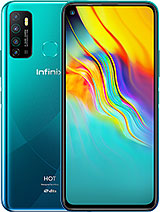
At 185 grams and 8.8 mm thick, the Hot 9 feels substantial without being heavy. The glass front and plastic back-and-frame construction is exactly what you'd expect for a sub-$100 phone in 2020. The 6.6-inch body is tall and narrow (20:9), which works for one-handed use despite the size, though the thick bezels give it an older look compared to contemporary rivals. Dual nano-SIM slots without eSIM support are a practical touch for switching carriers or balancing work and personal lines, still common in global-south markets. Nothing here surprises or disappoints; it's built for durability on a budget, not style.
Display
The 6.6-inch IPS LCD at 720p (266 ppi) is the first real compromise. It's readable indoors and fine for video apps—the 20:9 aspect ratio suits streaming—but text is noticeably softer than sharper phones, and small details blur if you look closely. This resolution was already stretched on a 6.6-inch screen in 2020, and it shows. Colors are acceptable on IPS, and brightness is adequate for average indoor light, but there's no protection glass listed, so scratches may accumulate. For casual browsing and messaging, you won't be bothered; for reading small text or demanding work, it falls short.
Performance
The MediaTek Helio A25 (octa-core Cortex-A53 at up to 1.8 GHz) is entry-level compute for 2020. WhatsApp, email, light web use, and turn-based games run without hiccups. Heavy multitasking or 3D gaming at high settings is where it struggles—you'll see stuttering and thermal throttling if you push it. The GPU (PowerVR GE8320) is dated even by budget standards. Pair this with 2–3 GB of RAM on the base models and you're in slow-phone territory; jumping to 4 GB helps, but the CPU remains the limiting factor. For someone checking messages and reading news, this is fine. For anything else, it's a daily frustration.
Software
Android 10 with Infinix's XOS 6.0 skin. The customization is light and mostly unobjectionable, though update support from a 2020 Infinix phone was never going to be extensive. You get essential apps and FM radio, which is useful in markets where streaming may not be reliable. No major bloat, and the OS runs reasonably smoothly given the hardware. It's functional; don't expect system-level polish or timely patches.
Camera
The 13 MP or 16 MP main camera (depending on RAM/storage tier) with PDAF and a 2 MP macro lens is serviceable in daylight. The 1.12 µm pixel size means fine detail softens, and the lack of optical zoom leaves distant subjects blurry. Night shots are weak—the triple-LED flash helps, but computational photography is minimal here. The 8 MP selfie camera is basic and exposure-weighted. Videos max out at 1080p@30fps with no stabilization. For sharing on messaging apps, it's acceptable; for anything beyond casual snapshots, you're not getting strong results.
Battery & charging
The 5000 mAh battery is the phone's defining strength. With light use (messaging, calls, some browsing), you can comfortably skip a day's charge; even moderate use should net you a full day. Heavy streaming or gaming drains it to half in around 6 hours. The spec sheet doesn't list charging wattage, which is telling—at this price in 2020, charging speed was likely slow (probably 5–10W), so even that big battery takes hours to refill. No fast charging, no wireless charging. It's a trade-off: buy yourself time between outlet visits, but accept a long wait when you do plug in.
Value & verdict
At around 90 EUR in 2020, the Hot 9 competed well against other budget phones because it promised battery longevity and dual SIM without gimmicks. Today (2026, reviewing a discontinued phone), it's a relic of an era when 720p on a 6.6-inch screen was defended as acceptable. For markets where internet is intermittent and charging is inconvenient, the battery still wins. For anyone else, modern budget phones at similar prices offer sharper displays, faster chips, and better cameras. If you need a phone that lasts days on one charge and that's your only priority, the Hot 9 still works. Otherwise, move on.
Verdict
The Hot 9 suits users in markets with spotty electricity or internet who prioritize battery life and dual SIM over modern performance or camera quality. Anyone else should look at a 2020-era Redmi or Samsung in the same price bracket, which offer sharper displays and faster chips without sacrifice."
- 5000 mAh battery delivers 1.5–2 days of light use, cutting daily charging pressure
- Dual nano-SIM slots without sacrificing expandable storage (dedicated microSD slot)
- Lightweight and comfortable to hold despite the large 6.6-inch screen
- FM radio and functional software for low-internet environments
- 720p display on a 6.6-inch screen is blurry by 2020 standards, with soft text and poor fine detail
- Helio A25 chipset struggles with multitasking and anything beyond casual use
- Charging speed not listed and likely very slow given the era and price tier
Infinix Hot 9 Key Specifications
The essentials at a glance. See the full spec sheet.
| Released | 2020, March 23. Released 2020, April |
|---|---|
| Display | 6.6 inches, 105.2 cm2 (~82.8% screen-to-body ratio), IPS LCD |
| Resolution | 720 x 1600 pixels, 20:9 ratio (~266 ppi density) |
| Chipset | Mediatek MT6762D Helio A25 (12 nm) |
| RAM & storage | 32GB 2GB RAM, 32GB 3GB RAM, 64GB 3GB RAM, 64GB 4GB RAM, 128GB 4GB RAM |
| Main camera | 13 MP, (wide), 1/3.1", 1.12µm, PDAF 2 MP (macro) Auxiliary lenses or 16 MP, (wide), PDAF (64/128 GB models only) 2 MP (macro) Auxiliary lenses |
| Selfie camera | 8 MP, (wide) |
| Battery | 5000 mAh |
| Software | Android 10, XOS 6.0 |
| Dimensions | 165.4 x 76.8 x 8.8 mm (6.51 x 3.02 x 0.35 in) |
| Weight | 185 g (6.53 oz) |
| Build | Glass front, plastic back, plastic frame |
| Network | GSM / HSPA / LTE |
| NFC | No |
| USB | microUSB 2.0, OTG |
Infinix Hot 9 FAQ
Common questions, answered from the spec sheet.
Does the Hot 9 support 5G?
No. The Hot 9 tops out at GSM / HSPA / LTE, without 5G.
What chipset does the Hot 9 use?
The Hot 9 runs on the Mediatek MT6762D Helio A25 (12 nm).
What display does the Hot 9 have?
A 6.6 inches, 105.2 cm2 (~82.8% screen-to-body ratio) IPS LCD, 720 x 1600 pixels, 20:9 ratio (~266 ppi density).
How big is the Hot 9 battery?
The Hot 9 has a 5000 mAh battery.
Does the Hot 9 have NFC?
No, the Hot 9 does not list NFC support.
Does the Hot 9 support a microSD card?
Yes, the Hot 9 supports expandable storage (microSDXC (dedicated slot)).
Does the Hot 9 have a headphone jack?
Yes, the Hot 9 has a 3.5mm headphone jack.
Alternatives to consider
If the Hot 9 isn’t quite right, these are the closest calls.
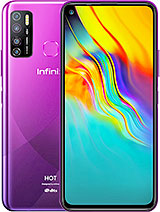
Hot 9 Pro

Hot 9 Play

Hot 10 Lite

Hot 10
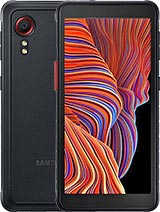
Galaxy XCover 5