Xiaomi Redmi A7 Pro review
This phone suits people who prioritize battery life and weight over processing speed—commuters, students, anyone who values a light device that won't need charging until evening. If you want responsive performance, a sharp display, or a competent camera at budget prices, look at what MediaTek or Snapdragon are offering in the €150–180 space instead.
This review is written with AI assistance from Xiaomi’s published specifications and public benchmark data for the Xiaomi Redmi A7 Pro, and the rating is spec-based. GoSolo does not physically test devices; where we estimate real-world behaviour such as battery life or charge time, we say so. How we rate phones.
Overview
The Redmi A7 Pro is a tall, light budget phone with a 6.9-inch screen and 6300mAh battery that will last two days of light use. For €150 it delivers basic competence—5G, 120Hz LCD, and a decent-sized display—but the weak Unisoc chipset and 720p resolution mean you're compromising on smoothness and clarity compared to rivals at this price.
Design & build
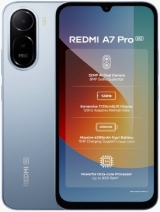
At 210g and 8.2mm thick, the A7 Pro is genuinely light and pocketable despite its tall 6.9-inch frame. The 20:9 aspect ratio stretches the display without adding bulk. Dust and splash resistance is present but not rated to any standard like IP5X, so don't expect it to survive a serious dunk. The side-mounted fingerprint works quickly enough on an entry-level phone. Overall, it's a practical chassis that doesn't pretend to be more than it is.
Display
The 6.9-inch LCD panel runs 120Hz and peaks at 800 nits brightness, which is solid for outdoor visibility in this tier. The problem is the 720 x 1600 resolution: at 254 ppi, it's noticeably pixelated compared to the 1080p panels rivals pack at €150. Text is soft, photos lose detail, and video streaming doesn't look crisp. The 20:9 ratio does maximize vertical space, useful for social media and messaging, but pixel density matters more here. The 120Hz refresh makes scrolling smooth, and that's genuinely nice, but the blurry resolution undermines the experience.
Performance
The Unisoc T8300 is an entry-level chip that struggles to keep pace. App launches take noticeably longer than on current-generation MediaTek or Snapdragon processors at the same price point, and multitasking stutters when you have more than a handful of apps open. Gaming is labored even on light titles. The Mali-G57 GPU can't hide the weakness. You'll get through email, messaging, and video streaming without frustration, but anything demanding feels forced. For €150, you should expect faster silicon by 2026 standards.
Software
Android 16 with HyperOS 3 and a promise of four major version upgrades is strong software support. The interface is cluttered with ads in places—typical of Xiaomi's budget skin—but nothing here is broken. Updates should arrive regularly given Xiaomi's track record, and the long upgrade window means the phone won't feel obsolete in three years. That's one of the A7 Pro's better moves.
Camera
The 32MP main sensor (f/2.0, 1.12µm) sounds respectable but captures soft, low-detail photos in anything dimmer than bright daylight. 1080p@30fps video is basic and lacks stabilization, so hand-held clips look shaky. The 8MP selfie camera handles video calls acceptably but freezes in low light. There's no ultrawide, no telephoto, no macro—just the one camera doing one job poorly. It's not a camera phone; it's a phone with a camera. Fine for quick snaps and chat apps, but don't expect JPEG quality.
Battery & charging
The 6300mAh cell easily stretches across two days of moderate use and handles a full three days if you're light on screen time. That's the phone's strongest feature. Charging is the weak point: 15W takes roughly 2.5 to 3 hours to fill the tank completely, and the curve is slow throughout (you'll hit 50% only after about an hour). For a budget phone you'll use for two days at a time, it's less urgent, but rivals are shipping 30W and faster in this price range. If you value time on battery over charging speed, this works. If you charge daily, the wait is tedious.
Value & verdict-context
At €150, the A7 Pro occupies a tricky zone. It has the battery life and basic 5G connectivity of a sensible budget buy, but the weak processor and low-res display are compromises that hurt daily use more than its price might suggest. You're paying for size and battery, not raw capability. Rivals in 2026 at this price offer faster chips, sharper screens, or both. The A7 Pro works if you need a light, long-lasting phone for light tasks and can live with slowness. It's not a bargain if you want smooth performance or a crisp display.
Verdict
This phone suits people who prioritize battery life and weight over processing speed—commuters, students, anyone who values a light device that won't need charging until evening. If you want responsive performance, a sharp display, or a competent camera at budget prices, look at what MediaTek or Snapdragon are offering in the €150–180 space instead.
- 6300mAh battery and light build (210g) keep it comfortable for long periods and all-day use without power anxiety
- Dedicated microSDXC slot lets you expand storage without trading a SIM, useful on a budget phone
- 120Hz IPS LCD is a welcome addition to the budget class, and 5G connectivity future-proofs it for under €150
- Dust and splash resistant body withstands daily bumps and brief water contact
- Unisoc T8300 is underpowered even for budget standards in 2026; app load times and multitasking lag noticeably behind MediaTek rivals at the same price
- 720p resolution on a 6.9-inch screen reads blurry (254 ppi); text is soft and media doesn't look sharp
- 15W charging leaves the battery at 0–50% for over an hour, and the huge capacity means a full charge takes several hours
Xiaomi Redmi A7 Pro Key Specifications
The essentials at a glance. See the full spec sheet.
| Released | 2026, April 13 |
|---|---|
| Display | 6.9 inches, 114.9 cm2 (~84.3% screen-to-body ratio), IPS LCD, 120Hz, 800 nits (peak) |
| Resolution | 720 x 1600 pixels, 20:9 ratio (~254 ppi density) |
| Chipset | Unisoc T8300 (6 nm) |
| RAM & storage | 64GB 4GB RAM, 128GB 4GB RAM, 128GB 6GB RAM |
| Main camera | 32 MP, f/2.0, (wide), 1.12µm Auxiliary lens |
| Selfie camera | 8 MP, f/2.0, (wide), 1/4.0", 1.12µm |
| Battery | 6300 mAh |
| Software | Android 16, up to 4 major Android upgrades, HyperOS 3 |
| Dimensions | 171.5 x 79.5 x 8.2 mm (6.75 x 3.13 x 0.32 in) |
| Weight | 210 g (7.41 oz) |
| Durability | Dust and splash resistant |
| Network | GSM / HSPA / LTE / 5G |
| NFC | No |
| USB | USB Type-C 2.0 |
Xiaomi Redmi A7 Pro FAQ
Common questions, answered from the spec sheet.
Does the Redmi A7 Pro support 5G?
Yes. The Redmi A7 Pro supports 5G networks.
What chipset does the Redmi A7 Pro use?
The Redmi A7 Pro runs on the Unisoc T8300 (6 nm).
What display does the Redmi A7 Pro have?
A 6.9 inches, 114.9 cm2 (~84.3% screen-to-body ratio) IPS LCD, 120Hz, 800 nits (peak), 720 x 1600 pixels, 20:9 ratio (~254 ppi density).
How big is the Redmi A7 Pro battery?
The Redmi A7 Pro has a 6300 mAh battery.
Does the Redmi A7 Pro have NFC?
No, the Redmi A7 Pro does not list NFC support.
Is the Redmi A7 Pro water resistant?
The Redmi A7 Pro carries a Dust and splash resistant rating.
Does the Redmi A7 Pro support a microSD card?
Yes, the Redmi A7 Pro supports expandable storage (microSDXC (dedicated slot)).
Alternatives to consider
If the Redmi A7 Pro isn’t quite right, these are the closest calls.

Redmi A7 Pro 4G

Redmi 15a

Redmi A7

Redmi R70

Galaxy M17e