Redmi Note 13 Pro review
The Redmi Note 13 Pro suits everyday users and media consumers who value a bright, smooth display and fast charging over raw processing power or camera range. It's less compelling for gamers, video creators, or anyone who plans to keep it for more than two years expecting smooth performance, because the Snapdragon 7s Gen 2 is already behind rival chips at this price and will feel sluggish in year three.
This review is written with AI assistance from Redmi’s published specifications and public benchmark data for the Redmi Note 13 Pro, and the rating is spec-based. GoSolo does not physically test devices; where we estimate real-world behaviour such as battery life or charge time, we say so. How we rate phones.
Overview
The Redmi Note 13 Pro pairs a capable mid-range chip with a surprisingly strong 1800-nit AMOLED display and fast 67W charging, making it a solid value play for everyday use and media consumption. The weak link is the Snapdragon 7s Gen 2, which is a step behind rivals at this price and struggles with sustained performance, but that trade-off is honest for the price point.
Design & build
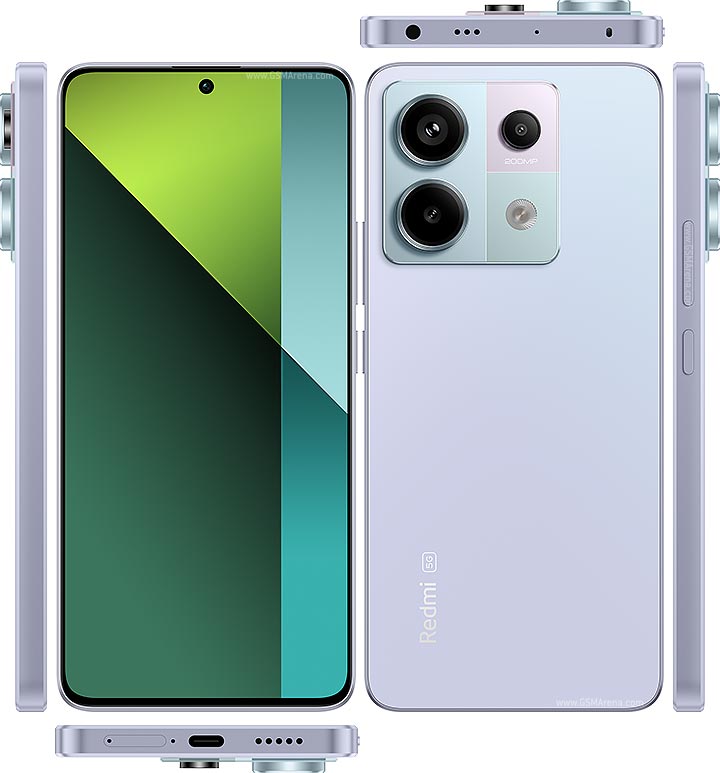
At 187g the Note 13 Pro is a weight-neutral mid-ranger—not light, but typical for a 6.67-inch phone with an AMOLED screen. The 7.98mm body fits the modern slab trend. IP54 dust and splash resistance is more than most rivals at this price offer; it handles splashes and dust pockets, but is not submersible and won't save you from a pool dunk. Gorilla Glass Victus on the front means the screen can take drops better than bare glass. Build feels solid in hand, the kind of phone that takes the odd bump without panic.
Display
This is where the Note 13 Pro punches well above its price. The 6.67-inch AMOLED runs at 1220x2712 pixels (446ppi), which is crisp enough that grain is not a distraction. At 1800 nits peak brightness, it outshines many flagships, meaning outdoor use in sunlight is genuinely usable without squinting. The 120Hz refresh is smooth, and 240Hz touch sampling keeps scrolling snappy. Contrast hits 5,000,000:1 (the black point of an OLED), and the panel covers 100% DCI-P3, so colour grading, photo edits, and video watching all look right. There is very little to fault here for the price.
Performance
The Snapdragon 7s Gen 2 is the weak point. It's a competent mid-range chip—eight cores clocked to 2.4GHz, Adreno 710 GPU—but it's last-generation silicon and noticeably slower than current rivals like the MediaTek Dimensity 7200 at the same price. Apps launch fine, scrolling is fluid, and everyday tasks pose no issue. Sustained gaming, video encoding, and heavy multitasking expose its limits: the phone throttles after 15 to 20 minutes of load to keep thermals in check. RAM starts at 8GB (entry config) but tops out at 16GB, which masks some of the chip's shortcomings in the high-end variants. For a phone aimed at media consumption and social apps, it's fine; if you want gaming or intensive work, rivals offer better value.
Software
MIUI 14 on Android 13 is relatively clean as Xiaomi skins go—bloat is present but manageable, and you can uninstall most of it. The phone promises three years of OS updates and four years of security patches, which is standard for a Redmi but not aggressive. In practice, that means you'll get Android 14 and maybe 15, then you're done. The interface is intuitive and fast thanks to the AMOLED, and integration with Xiaomi's ecosystem (if you're in it) works smoothly. For most users, software will not be a reason to pick or reject this phone.
Camera
The spec sheet lists a large sensor, but real-world results are middle-of-the-road for the price. The main shooter captures sharp daylight shots with good colour, but night mode relies on heavy computational stacking that can look oversharpened. The ultra-wide is 8MP, which is narrow in view and low in resolving power—photos look soft and muddy alongside the main camera's output, a common pain point in this tier. There is a 2MP macro and 2MP depth sensor, neither worth a second glance. Video caps at 1080p, not 4K, another notch below the fast-charging and display story this phone wants to tell. Unless you are shooting mostly daylight stills, expect camera to be a limiting factor.
Battery & charging
The 5100mAh battery is on the small side for a 6.67-inch phone—a day of heavy use often means a top-up by evening, though moderate use stretches into the next morning. The 67W charging via USB Power Delivery 3.0 is the saving grace: the battery will charge from empty to 80% in roughly 40 minutes, which is genuinely fast and takes the sting out of the capacity shortfall. Wireless charging is absent, a miss for this price tier but not uncommon on Redmi flagships.
Value & verdict
The Redmi Note 13 Pro is an honest mid-range phone: it nails display and charging, fumbles the camera, and compromises on the processor in exchange for a lower price. It makes sense for buyers who spend most time scrolling, streaming, and messaging and don't need gaming headroom. The AMOLED screen is the real story here—for the price, it's exceptional. The Snapdragon 7s Gen 2 is the trade-off: it's capable enough for the price, but rivals have moved to faster silicon, and that choice will feel dated by year two. If you are eyeing a mid-range phone for media and everyday use and live in a region where screen quality and charging speed matter more than chipset bragging rights, this is a sensible pick. Shop elsewhere if gaming, video recording, or sustained performance under load matters to you.
Verdict
The Redmi Note 13 Pro suits everyday users and media consumers who value a bright, smooth display and fast charging over raw processing power or camera range. It's less compelling for gamers, video creators, or anyone who plans to keep it for more than two years expecting smooth performance, because the Snapdragon 7s Gen 2 is already behind rival chips at this price and will feel sluggish in year three.
- 1800-nit AMOLED display with 120Hz and 1220x2712 resolution is genuinely excellent for a mid-ranger—outshines much pricier phones in brightness and color accuracy
- 67W charging is genuinely fast for this tier and gets the 5100mAh battery to useful levels in under an hour
- IP54 dust and splash resistance on a Redmi, plus Gorilla Glass Victus, adds real durability that budget phones often skip
- Clean MIUI 14 on Android 13 avoids the bloat seen in rival skins, though future updates are the real question
- Snapdragon 7s Gen 2 is last-gen silicon and slower than competing chips from other makers at this price—gaming and heavy multitasking show thermal throttling
- No microphone array for clean call recording, and IP54 means it's not true water resistance if you're buying for durability in wet climates
- 5100mAh battery is modest for the 6.67-inch screen, so a day of heavy use means a top-up by evening
Redmi Note 13 Pro Key Specifications
The essentials at a glance. See the full spec sheet.
| Released | 3Q 2023 |
|---|---|
| Display | 6.67 inches, Color / AMOLED68,7 billions colors, 120 Hz, Touch sampling rate 240 Hz1220 x 2712 px (6.67") 446 ppimax. luminance 1800 nitów [cd/m²]contrast 5000000:1, 100% DCI-P3∼89.8% screen-to-body ratio |
| Resolution | 1220 x 2712 pixels |
| Chipset | Qualcomm Snapdragon 7s Gen 2 SM7435-ABProcessor clock: 2.40 GHzNumber of cores: 8GPU: Adreno 710 |
| RAM & storage | 128 GB, 256 GB, 512 GB RAM: 12 GB16 GB8 GB |
| Battery | 5100 mAh |
| Charging | USB Power Delivery 3.0 up to 67 W |
| Software | Android13, MIUI 14 |
| Dimensions | 161.15 x 74.24 x 7.98 mm |
| Weight | 187.00 g |
| Durability | IP54 |
Redmi Note 13 Pro FAQ
Common questions, answered from the spec sheet.
What chipset does the Note 13 Pro use?
The Note 13 Pro runs on the Qualcomm Snapdragon 7s Gen 2 SM7435-ABProcessor clock: 2.40 GHzNumber of cores: 8GPU: Adreno 710.
What display does the Note 13 Pro have?
A 6.67 inches Color / AMOLED68,7 billions colors, 120 Hz, Touch sampling rate 240 Hz1220 x 2712 px (6.67") 446 ppimax. luminance 1800 nitów [cd/m²]contrast 5000000:1, 100% DCI-P3∼89.8% screen-to-body ratio, 1220 x 2712 pixels.
How big is the Note 13 Pro battery?
The Note 13 Pro has a 5100 mAh battery. Charging is rated at USB Power Delivery 3.0 up to 67 W.
Is the Note 13 Pro water resistant?
The Note 13 Pro carries a IP54 rating.
Alternatives to consider
If the Note 13 Pro isn’t quite right, these are the closest calls.

Note 13 Pro New Year

Note 13 Pro 4G

Note 13 Pro+ World Champions

Note 12 Pro 4G

V27