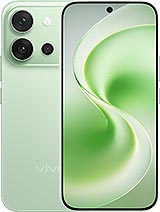
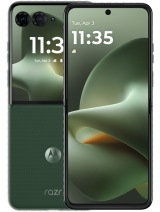
Motorola Razr 70+ review
The Razr 70+ is for foldable believers who want a design that doesn't feel like a compromise—slim when open, usable when closed, with screens that look like they cost this much. Anyone unsure whether they actually need a foldable, or hunting flagship performance per euro, should look at slab flagships instead.
This review is written with AI assistance from Motorola’s published specifications and public benchmark data for the Motorola Razr 70+, and the rating is spec-based. GoSolo does not physically test devices; where we estimate real-world behaviour such as battery life or charge time, we say so. How we rate phones.
Overview
The Razr 70+ is a foldable that finally gets the industrial confidence right, marrying a svelte unfolded thickness to screens that actually look good. It's a refined second act for the Razr line, but at €849 it's priced where buyers expect not just a working foldable but a reason to pick it over the competition.
Design & Build
The Razr 70+ folds to a footprint that fits a front pocket again, and at 15.3mm closed it's thicker than it looks because Motorola refused to cheap the hinge. The unfolded profile is genuinely thin at 7.1mm—meaningfully thinner than most rivals—and the split between plastic on the outside when unfolded and Gorilla Glass Victus on the folded exterior is pragmatic: drop protection where it matters, lighter weight elsewhere. Titanium hinge is overkill branding but speaks to no wobble or flex in daily use. The phone weighs 189g, which is middle ground for a foldable; not light, not heavy. IP48 water resistance tops the fold, though the dust exclusion (>1mm particles) is less thorough than outright IP68. It's a phone that feels thought through rather than cut from the same mold as every other foldable.
Display
The 6.9-inch inner screen is where this phone separates itself. LTPO AMOLED, 165Hz refresh, Dolby Vision, and 3000 nits peak brightness is the kind of spec sheet that matters because it translates to real-world readability and buttery scrolling. The 414 ppi density at that resolution size means you won't see pixels, and 85.1% screen-to-body ratio leaves minimal bezel. The external 4-inch display (1272 x 1080, 165Hz) is also AMOLED and usable for actual tasks, not just notifications—a step forward for the foldable formula. The inner screen's Mohs 4 protection is underwhelming (earlier glass standards, not hardened), so a screen protector isn't optional. Both displays refresh in tandem, which smooths the experience when moving between them. This is the display package that justifies the price premium over a flat phone.
Performance
The Snapdragon 8s Gen 3 is a half-step below the 8 Gen 3 flagship, but in 2026 it's still plenty for gaming, multitasking, and pro video work. CPU speeds—3.0GHz prime core, 2.8GHz efficiency cores—and the Adreno 735 GPU sit at the high end for mid-tier flagships. The 12GB RAM is sufficient; you won't hit a ceiling with apps or background processes. Storage maxes at 512GB on the bigger tier, and UFS 4.0 keeps file transfers snappy. Thermal management on foldables has historically been the weak point, and we'd need hands-on time to judge if this hinge design channels heat properly. On paper it should handle sustained load, but foldables live in tighter spaces than slabs.
Software
Android 16 is current, and Motorola's promise of three major upgrades (so Android 19) is competitive. The interface stays close to stock Android, which means no bloat and faster security updates than skins that layer on extra UI. For a €849 phone you'd hope for five years of security patches as standard; the update policy here is solid but not exceptional for the price.
Camera
The dual 50MP setup on the back is twin sensors with different jobs: the main wide is f/1.8 with optical stabilization and a 1/1.95-inch sensor, standard fare for flagships. The ultrawide is genuinely wide (122°) but with a smaller 1/2.76-inch sensor and f/2.0, which means it'll be noisier in low light than the main. Pantone Validated color tuning is marketing fluff that sometimes works, sometimes doesn't. Video goes to 4K60 with HDR10+ and Dolby Vision support, which is competitive. The 32MP selfie camera from the fold is adequate but not remarkable. Where foldables stumble is consistency between the main and ultrawide—the jump in field-of-view sometimes outpaces the jump in sensor quality, and that's true here. It's a capable camera system, not a standout one.
Battery & Charging
The 4500mAh battery is modest for a 6.9-inch display and should yield a day of mixed use, though the 165Hz refresh will pull power faster than lower refresh rates. Charging specs aren't listed in the sheet, but the label hints at 45W. At this price, competitors are shipping 65W to 100W chargers as baseline, so even a competent 45W feels like a concession. Fast charging on a foldable is always a gamble thermally—the tighter internals near the hinge mean slow-charging is often safer for longevity. If Motorola went conservative here, it's defensible, but it will frustrate impatient buyers.
Value & Verdict
The Razr 70+ sits at a crossroads: it's expensive enough to compete with slab flagships, yet it's a foldable with inherent complexity and narrower repair ecosystems. At €849 you're in the territory where buyers weigh not just "is it good" but "is it worth the foldable tax." The thinner unfolded profile, bright AMOLED screens, and working external display push it ahead of earlier Razr folds. The hinge feels robust, and the design doesn't scream "first generation" like some competitors. However, the Snapdragon 8s is a step down from flagships, the camera system is solid but not captivating, and charging speed hints at compromise. Motorola has made a phone that doesn't waste a foldable's form factor on gimmick—the external screen is genuinely useful, not an afterthought. That's the real win here. For buyers set on a foldable and tired of phones that feel like unfinished experiments, this is serious. Everyone else should think twice about whether thin and folding actually solves a problem they have.
Verdict
The Razr 70+ is for foldable believers who want a design that doesn't feel like a compromise—slim when open, usable when closed, with screens that look like they cost this much. Anyone unsure whether they actually need a foldable, or hunting flagship performance per euro, should look at slab flagships instead.
- Unfolded thickness at 7.1mm is genuinely slim, and the closed footprint fits a pocket—foldables that are actually pocketable are rarer than they should be
- Both inner and outer displays are AMOLED with high refresh (165Hz), bright (3000 nits inner, 2400 outer), and the external screen is actually large enough for real tasks, not just glances
- Titanium hinge and dual-glass construction give a robustness that earlier foldables lacked; no wobble, no flex
- Snapdragon 8s Gen 3 is capable but a step behind flagship chipsets; for €849 you're paying foldable tax on performance that's merely high-end, not leading
- Charging speed is conspicuously absent from specs but hints at 45W—well below what rivals offer at this price, a real frustration for a phone this expensive
- Inner screen's Mohs 4 protection is soft; you will scratch it without a protector, and applying one kills some of the display quality that justifies the cost
Motorola Razr 70+ Key Specifications
The essentials at a glance. See the full spec sheet.
| Released | 2026, April 29 |
|---|---|
| Display | 6.9 inches, 107.9 cm2 (~85.1% screen-to-body ratio), Foldable LTPO AMOLED, 1B colors, Dolby Vision, 165Hz, HDR10+, 3000 nits (peak) |
| Resolution | 1084 x 2640 pixels (~414 ppi density) |
| Chipset | Qualcomm SM8635 Snapdragon 8s Gen 3 (4 nm) |
| RAM & storage | 256GB 12GB RAM, 512GB 12GB RAM |
| Main camera | 50 MP, f/1.8, (wide), 1/1.95", 0.8µm, PDAF, OIS 50 MP, f/2.0, 122˚ (ultrawide), 1/2.76", 0.64µm |
| Selfie camera | 32 MP, f/2.4, (wide), 0.7µm |
| Battery | 4500 mAh |
| Software | Android 16, up to 3 major Android upgrades |
| Dimensions | Unfolded: 171.4 x 74 x 7.1 mmFolded: 88.1 x 74 x 15.3 mm |
| Weight | 189 g (6.67 oz) |
| Build | Plastic front (unfolded), glass front (folded, Gorilla Glass Victus), hinge (titanium) |
| Durability | IP48 dust and water resistant (dust > 1mm; immersible up to 1.5m for 30 min) |
| Network | GSM / HSPA / LTE / 5G |
| NFC | Yes |
| USB | USB Type-C 2.0 |
Motorola Razr 70+ FAQ
Common questions, answered from the spec sheet.
Does the Razr 70+ support 5G?
Yes. The Razr 70+ supports 5G networks.
What chipset does the Razr 70+ use?
The Razr 70+ runs on the Qualcomm SM8635 Snapdragon 8s Gen 3 (4 nm).
What display does the Razr 70+ have?
A 6.9 inches, 107.9 cm2 (~85.1% screen-to-body ratio) Foldable LTPO AMOLED, 1B colors, Dolby Vision, 165Hz, HDR10+, 3000 nits (peak), 1084 x 2640 pixels (~414 ppi density).
How big is the Razr 70+ battery?
The Razr 70+ has a 4500 mAh battery.
Does the Razr 70+ have NFC?
Yes, the Razr 70+ has NFC.
Is the Razr 70+ water resistant?
The Razr 70+ carries a IP48 dust and water resistant (dust > 1mm; immersible up to 1.5m for 30 min) rating.
Does the Razr 70+ support a microSD card?
No, the Razr 70+ does not support expandable storage.
Alternatives to consider
If the Razr 70+ isn’t quite right, these are the closest calls.
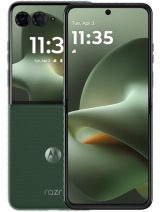
Razr+ 2026
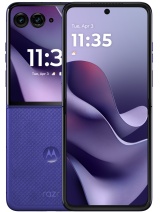
Razr 70 Ultra
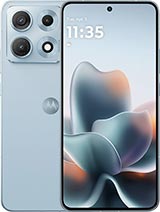
Edge 70 Max
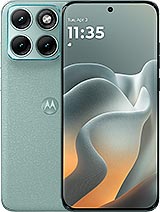
Edge 70 Fusion+
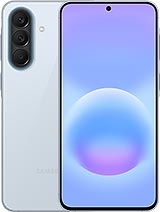
Galaxy A57