Apple iPad Pro 12.9-inch (4th generation) [2020] review
This suits anyone who works primarily with large documents, sketching, or light photo editing and values the 12.9-inch canvas over raw processing speed. Skip it if you plan intensive video rendering, demand the latest chip, or simply want a tablet for Netflix and email—the older hardware and brightness limitations do not justify the price for casual use.
![iPad Pro 12.9-inch (4th generation) [2020] product photo](https://api.mobileapi.dev/devices/868/thumb.png)
This review is written with AI assistance from Apple’s published specifications and public benchmark data for the Apple iPad Pro 12.9-inch (4th generation) [2020], and the rating is spec-based. GoSolo does not physically test devices; where we estimate real-world behaviour such as battery life or charge time, we say so. How we rate phones.
Overview
The iPad Pro 12.9 (2020) is a large, capable tablet for creative work—drawing, video editing, document markup—with a smooth 120Hz display and long battery life. It's overkill if you mainly browse and watch video, and its A12Z chip now lags behind the M-series models that replaced it.
Design & Build
At 641 grams and 5.9mm thick, this feels like a solid slab of glass and aluminum—built to last but undeniably heavy for one-handed use. The larger 12.9-inch frame makes it awkward to hold without a case or stand, and at 280mm wide it demands a proper lap or table. This is a working tablet, not a portable consumption device. The aluminum frame and oleophobic glass are durable, and it pairs seamlessly with the Apple Pencil (2nd gen) and Magic Keyboard, which turn it into a pseudo-laptop setup. If you buy it used now in 2026, expect wear on the edges and a battery that may only give 8–10 hours. The design itself is not a weakness; it is designed for desk work.
Display
The 12.9-inch IPS LCD with 120Hz refresh is the standout. That 120Hz smoothness matters more on a tablet than almost anywhere else—sketching, scrolling through long documents, and panning in design apps all feel fluid. The 4:3 aspect ratio is ideal for documents and creative work, and the 2048×2732 resolution delivers 265 ppi, which is sharp enough at arm's length. The catch: 600 nits is bright enough for indoors but is not competitive with newer iPad Pro models that push 800+ nits. Sit it in a window or under harsh light and the display washes out. For a device that shipped in 2020, this is a respectable panel, but it shows its age against current tablets.
Performance
The A12Z Bionic (an octa-core chip with 4x2.5GHz Vortex cores and an 8-core GPU) handles everything most users throw at it: Procreate, Adobe Lightroom and Premiere, document editing, web browsing. Multitasking across apps and split-screen workflows runs smooth. The GPU's eight cores are overkill for casual use but actually valuable if you do regular video editing or 3D work. The real caveat is that this is a 2020 chip. Newer iPad Pro units with the M1 and M2 export video and render 3D scenes visibly faster. If you are a professional editor on a deadline, that matters. If you sketch and edit photos casually, the A12Z is more than sufficient.
Camera
The 12MP main camera with f/1.8 aperture and dual-pixel PDAF shoots competent photos and video in daylight, and the 10MP ultrawide is useful for capturing larger scenes or groups. The standout is the LiDAR scanner, which adds depth-sensing capability—apps can now measure room dimensions, furniture placement, and object depth without you fumbling with a tape measure. In practice, this is genuinely handy for field work, real estate, or spatial design tasks. The 7MP selfie camera is fine for video calls. Tablet cameras are never a strength; this one is no exception, but the LiDAR pushes it slightly ahead of the usual point-and-forget rear module.
Battery & Charging
The 9720 mAh battery translates to roughly 10–12 hours of screen-on time for mixed use (email, browsing, light video). Heavy video editing or drawing will shorten that to 8–10 hours, but for a single workday without a charge, this holds up. The specs do not list charging speed, which suggests a standard 10–20W charger in the 2020 model. Charging from flat to full takes 2–3 hours, which is leisurely by modern standards, but the battery lifespan means you will likely get 3–4 years before noticing visible degradation if the device is treated gently.
Software & Ecosystem
Out of the box it ships with iPadOS 13.4 but upgrades to iPadOS 26 (current as of 2026), which is a six-year software support window. Apps like Procreate, Affinity Designer, and Logic Pro remain optimized for iPad, and the ecosystem of stylus-aware and multitasking apps is now mature. Face ID unlock is present and works reliably. The lack of files, file manager integration, or true window management remains iPad's design choice, not a flaw of this model—your workflow is either compatible with iPadOS or it is not.
Value & Verdict
In 2026, this iPad Pro is a used or refurbished device, typically selling for 500–700 EUR depending on storage and condition. For that price, it undercuts a new base iPad Pro (which now starts with an M4 chip) by several hundred euros, and the 12.9-inch screen is a genuine size and feature advantage over the standard iPad. The trade-off is a 2020 processor and dimmer display. If you are a student who sketches notes, an architect reviewing plans, or a photographer culling shots, the large screen and LiDAR are worth it. If you want the latest performance for video work or expect to keep the device for 5+ years, spend the extra for the current M-series model. Do not buy this expecting it to feel new; buy it as a solid second-hand workhorse that will serve a specific, non-demanding creative task for another 2–3 years.
Verdict
This suits anyone who works primarily with large documents, sketching, or light photo editing and values the 12.9-inch canvas over raw processing speed. Skip it if you plan intensive video rendering, demand the latest chip, or simply want a tablet for Netflix and email—the older hardware and brightness limitations do not justify the price for casual use.
- Smooth 120Hz display makes sketching and scrolling feel responsive, a rare comfort on tablets even today
- All-day battery life (9–12 hours screen-on) with minimal hunting for a plug during typical work
- 8-core GPU handles video editing, design apps, and heavy multitasking without stuttering
- LiDAR scanner adds real utility for apps that measure space, depth, and objects—genuinely useful for field work and spatial planning
- A12Z Bionic is a 2020 chip; M1 and M2 iPad Pro models now render and export noticeably faster, making this feel incremental rather than current
- 600 nits brightness is fine indoors but struggles in direct sunlight, a real limitation if you work outside or near windows
- No USB connectivity beyond USB-C; no accessory expansion or legacy cable support if you already own iPad Pro cables from older generations
Apple iPad Pro 12.9-inch (4th generation) [2020] Key Specifications
The essentials at a glance. See the full spec sheet.
| Released | 2020, March 19 |
|---|---|
| Display | 12.9 inches, 515.3 cm2(~85.4% screen-to-body ratio), IPS LCD, 120Hz, 600 nits (typ) |
| Resolution | 2048 x 2732 pixels, 4:3 ratio (~265 ppi density) |
| Chipset | Apple A12Z Bionic |
| RAM & storage | 128GB 6GB RAM, 256GB 6GB RAM, 512GB 6GB RAM, 1TB 6GB RAM |
| Main camera | 12 MP, f/1.8, (wide), 1/3.0", 1.22µm, dual pixel PDAF10 MP, f/2.4, 11mm (ultrawide)TOF 3D LiDAR scanner (depth) |
| Selfie camera | 7 MP, f/2.2 |
| Battery | 9720 mAh |
| Software | iPadOS 13.4, upgradable to iPadOS 26 |
| Dimensions | 280.6 x 214.9 x 5.9 mm (11.05 x 8.46 x 0.23 in) |
| Weight | 641 g (Wi-Fi), 643 g (LTE) (1.41 lb) |
| Build | Glass front, aluminum back, aluminum frame |
| Durability | Stylus support |
| Network | GSM / CDMA / HSPA / EVDO / LTE |
| NFC | No |
| USB | USB Type-C 3.1, magnetic connector |
Apple iPad Pro 12.9-inch (4th generation) [2020] FAQ
Common questions, answered from the spec sheet.
Does the iPad Pro 12.9-inch (4th generation) [2020] support 5G?
No. The iPad Pro 12.9-inch (4th generation) [2020] tops out at GSM / CDMA / HSPA / EVDO / LTE, without 5G.
What chipset does the iPad Pro 12.9-inch (4th generation) [2020] use?
The iPad Pro 12.9-inch (4th generation) [2020] runs on the Apple A12Z Bionic.
What display does the iPad Pro 12.9-inch (4th generation) [2020] have?
A 12.9 inches, 515.3 cm2(~85.4% screen-to-body ratio) IPS LCD, 120Hz, 600 nits (typ), 2048 x 2732 pixels, 4:3 ratio (~265 ppi density).
How big is the iPad Pro 12.9-inch (4th generation) [2020] battery?
The iPad Pro 12.9-inch (4th generation) [2020] has a 9720 mAh battery.
Does the iPad Pro 12.9-inch (4th generation) [2020] have NFC?
No, the iPad Pro 12.9-inch (4th generation) [2020] does not list NFC support.
Is the iPad Pro 12.9-inch (4th generation) [2020] water resistant?
The iPad Pro 12.9-inch (4th generation) [2020] carries a Stylus support rating.
Does the iPad Pro 12.9-inch (4th generation) [2020] support a microSD card?
No, the iPad Pro 12.9-inch (4th generation) [2020] does not support expandable storage.
Does the iPad Pro 12.9-inch (4th generation) [2020] have a headphone jack?
No, the iPad Pro 12.9-inch (4th generation) [2020] does not have a 3.5mm headphone jack.
Alternatives to consider
If the iPad Pro 12.9-inch (4th generation) [2020] isn’t quite right, these are the closest calls.
![iPad Pro 11-inch (4th generation) [2020] product photo](https://api.mobileapi.dev/devices/877/thumb.png)
iPad Pro 11-inch (4th generation) [2020]
![iPad 10.2 (8th generation) [2020] product photo](https://api.mobileapi.dev/devices/886/thumb.png)
iPad 10.2 (8th generation) [2020]
![iPad Air (4th generation) [2020] product photo](https://api.mobileapi.dev/devices/887/thumb.png)
iPad Air (4th generation) [2020]
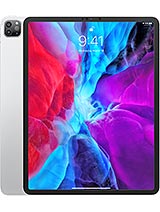
iPad Pro 12.9 2020
Galaxy Tab S6 5G