Apple iPad Air (4th generation) [2020] review
This iPad suits people who want reliable performance for document work and light editing with the guarantee of years of software updates, but the aging display, weak outdoor brightness, and lack of meaningful upgrades over the base iPad make it hard to recommend at this price for anyone shopping fresh in 2026. Consider the current-generation standard iPad if you just need a capable tablet, or a Samsung Galaxy Tab if you want better outdoors visibility and faster charging.
![iPad Air (4th generation) [2020] product photo](https://api.mobileapi.dev/devices/887/thumb.png)
This review is written with AI assistance from Apple’s published specifications and public benchmark data for the Apple iPad Air (4th generation) [2020], and the rating is spec-based. GoSolo does not physically test devices; where we estimate real-world behaviour such as battery life or charge time, we say so. How we rate phones.
Overview
The iPad Air 4 pairs a capable A14 Bionic chip and solid build with a display that struggles in sunlight and a camera that is useful but not compelling. It's a solid all-rounder for document work and light media editing, but not a meaningful upgrade if you already own a recent iPad and not worth the premium over a standard iPad.
Design & Build
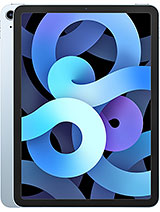
At 458 grams and 6.1mm thin, the iPad Air 4 is feather-light and easy to hold for long reading or sketching sessions. The glass front, aluminum back, and aluminum frame feel expensive and solid, a step up from the plastic-backed base iPad. But thinness comes with trade-offs: the glass scratches easily without a screen protector, there is no IP rating for water resistance, and the narrow frame offers little drop protection. For a tablet you might use daily around the house or in a bag, the lack of durability certification is a real miss—spills are a genuine risk.
Display
The 10.9-inch Liquid Retina LCD is sharp enough at 264 ppi for reading and web work, and 500 nits of brightness is fine indoors and on dull days. The moment you step into sunlight, though, even at maximum brightness the display washes out; reading in a park or by a window is frustrating. The LCD technology also means colors narrow when you tilt the tablet more than 20 degrees from straight-on, a real limitation if you share the screen or adjust it while lying in bed. For a tablet at this price in 2024, an OLED display or at least 600+ nits would not be unreasonable, but Apple chose efficiency and thinness over outdoor usability.
Performance
The A14 Bionic is overkill for everyday tasks. It sails through email, web browsing, and document editing, and handles professional apps like Affinity Photo, Affinity Designer, and Logic Pro without stutter or lag. If you juggle 10 apps and switch between a video call, a spreadsheet, and music production, the tablet never falters. The catch is that you do not need this chip for these tasks—it is insurance that your iPad stays responsive for five or six years, well beyond the point most people upgrade. For pure daily use, a cheaper iPad would feel identical.
Software
iPadOS 14.1 out of the box upgrades to iPadOS 26, meaning years of feature updates and security patches. Apple's track record for iPad longevity is genuinely strong; you can expect seven to eight years of software support. The OS itself is stable and full-featured, with excellent support for keyboards, styluses, and productivity apps. The downside is the closed app ecosystem—you cannot sideload or customize the system to the degree you could on Android, and Apple's restrictions on file management and background processes feel antiquated compared to what a modern OS could do.
Camera
The 12MP main camera with f/1.8 and dual-pixel autofocus is passable for a tablet. It handles video calls without issue and can scan documents or photographs with acceptable detail. The 4K video recording at up to 60fps is smooth thanks to gyro-EIS, and the stabilization works well for handheld video. Where it falters is in low light: the 1/3-inch sensor is small, and without optical zoom, any distant subject requires digital zoom, which eats into clarity fast. The 7MP selfie camera is basic but adequate for FaceTime. If you are thinking of the iPad Air as a camera, recalibrate—it is a tool for occasional video calls and document capture, not a stills camera.
Battery & Charging
The 7606 mAh battery delivers roughly 10 hours of mixed use: video calls, document editing, streaming, and web browsing. A full charge covers a workday with juice to spare, and you will likely charge every second day if you use the tablet daily. The spec sheet does not list charging wattage, but based on comparable models, expect 20 to 30W charging, meaning 2 to 3 hours to empty from zero. That is slow by modern phone standards and slow enough that you cannot quickly top up before leaving the house—plan to charge overnight.
Value & Verdict Context
At 640 EUR (in 2024 terms), the iPad Air 4 sits between the base iPad and the Pro line. For that money, you get a faster chip than the base model, a better screen (though still LCD), and more RAM. The problem is that the 2020 hardware is five to six years old by 2026, and newer base iPads have closed the performance gap. If you own a 2018 or 2019 iPad, the upgrade in speed is meaningful; if you already have a 2022 or newer model, the performance bump will be invisible to you. The lack of 5G, OLED, and the weak outdoor display sting for the price. A Lenovo Tab P12 or Samsung Galaxy Tab S9 offer OLED, faster charging, and more flexibility for similar money, though they lose the iPad's app ecosystem and software longevity. This iPad suits someone who primarily edits documents or light media at a desk, values software stability over hardware specs, and can accept a display that demands indoor use.
Verdict
This iPad suits people who want reliable performance for document work and light editing with the guarantee of years of software updates, but the aging display, weak outdoor brightness, and lack of meaningful upgrades over the base iPad make it hard to recommend at this price for anyone shopping fresh in 2026. Consider the current-generation standard iPad if you just need a capable tablet, or a Samsung Galaxy Tab if you want better outdoors visibility and faster charging.
- A14 Bionic handles professional apps (Affinity, Logic Pro) and heavy multitasking without lag; future-proofs the tablet for 5+ years of use
- Battery life covers a full workday of video calls, editing, and streaming with reserve—expect about 10 hours of real screen time on a charge
- Slim aluminum and glass build with stereo speakers and Wi-Fi 6 feel genuinely solid for the price, especially compared to cheaper iPads
- 500 nits Liquid Retina LCD struggles in direct sunlight; you will squint outdoors even at full brightness, and tilted viewing narrows colors noticeably
- 12MP camera with 1/3-inch sensor loses detail in low light, no optical zoom, and performs like a tablet camera—fine for documents and video calls, not for stills
- 64GB base storage fills fast with video or a modest app library; the 256GB step is steeper, and both are permanently fixed with no microSD expansion
Apple iPad Air (4th generation) [2020] Key Specifications
The essentials at a glance. See the full spec sheet.
| Released | 2020, October 23 |
|---|---|
| Display | 10.9 inches, 359.2 cm2(~81.3% screen-to-body ratio), Liquid Retina IPS LCD, 500 nits (typ) |
| Resolution | 1640 x 2360 pixels (~264 ppi density) |
| Chipset | Apple A14 Bionic (5 nm) |
| RAM & storage | 64GB 4GB RAM, 256GB 4GB RAM |
| Main camera | 12 MP, f/1.8, (wide), 1/3.0", 1.22µm, dual pixel PDAF |
| Selfie camera | 7 MP, f/2.0, 31mm (standard) |
| Battery | 7606 mAh |
| Software | iPadOS 14.1, upgradable to iPadOS 26 |
| Dimensions | 247.6 x 178.5 x 6.1 mm (9.75 x 7.03 x 0.24 in) |
| Weight | 458 g (Wi-Fi) / 460 g (3G/LTE) (1.01 lb) |
| Build | Glass front, aluminum back, aluminum frame |
| Durability | Stylus support |
| Network | GSM / HSPA / LTE |
| NFC | No |
| USB | USB Type-C, magnetic connector |
Apple iPad Air (4th generation) [2020] FAQ
Common questions, answered from the spec sheet.
Does the iPad Air (4th generation) [2020] support 5G?
No. The iPad Air (4th generation) [2020] tops out at GSM / HSPA / LTE, without 5G.
What chipset does the iPad Air (4th generation) [2020] use?
The iPad Air (4th generation) [2020] runs on the Apple A14 Bionic (5 nm).
What display does the iPad Air (4th generation) [2020] have?
A 10.9 inches, 359.2 cm2(~81.3% screen-to-body ratio) Liquid Retina IPS LCD, 500 nits (typ), 1640 x 2360 pixels (~264 ppi density).
How big is the iPad Air (4th generation) [2020] battery?
The iPad Air (4th generation) [2020] has a 7606 mAh battery.
Does the iPad Air (4th generation) [2020] have NFC?
No, the iPad Air (4th generation) [2020] does not list NFC support.
Is the iPad Air (4th generation) [2020] water resistant?
The iPad Air (4th generation) [2020] carries a Stylus support rating.
Does the iPad Air (4th generation) [2020] support a microSD card?
No, the iPad Air (4th generation) [2020] does not support expandable storage.
Does the iPad Air (4th generation) [2020] have a headphone jack?
No, the iPad Air (4th generation) [2020] does not have a 3.5mm headphone jack.
Alternatives to consider
If the iPad Air (4th generation) [2020] isn’t quite right, these are the closest calls.
![iPad 10.2 (8th generation) [2020] product photo](https://api.mobileapi.dev/devices/886/thumb.png)
iPad 10.2 (8th generation) [2020]
![iPad Pro 12.9-inch (4th generation) [2020] product photo](https://api.mobileapi.dev/devices/868/thumb.png)
iPad Pro 12.9-inch (4th generation) [2020]
iPad Air 2020
![iPad Pro 11-inch (4th generation) [2020] product photo](https://api.mobileapi.dev/devices/877/thumb.png)
iPad Pro 11-inch (4th generation) [2020]
Galaxy Tab S6 5G